
quietly observed, intensely felt
Review by Dr Amanda Geitner
This is an exhibition of notable firsts. In the inaugural year of the South Quay Gallery, Constructive is the first exhibition that Katarzyna Coleman and Bridget Heriz have made together. That is remarkable, given that the artists have lived in Great Yarmouth and been friends for over two decades. Each artist renowned, they are also key members of a close-knit community of artists that includes John Kiki, Emrys Parry and, until recently, Bruer Tidman. Tidman died in 2024 and the loss of him is still profoundly felt. This set of relationships is worth mentioning as it foregrounds the significance of Coleman and Heriz exhibiting together now, in a context which includes recent seismic events that are personal, local and global.
Kate Coleman’s work is drawn from the area directly surrounding her studio; the industrial harbour environment of South Denes, Great Yarmouth. Her compositions are developed from meticulous drawings of roads, buildings and roof tops observed from her car (on a quiet Sunday) or from a window. Some of the works on show reflect time spent drawing in the windows of South Quay Gallery, recording the river and the harbourside constructions beyond.
“This utilitarian landscape is suffused with unique, water- reflected light, transforming the everyday and familiar to something beautiful, mysterious and deeply human.”
Drawings are refined and scaled up to larger paintings in the studio. Coleman’s compositions are concerned with proportion, measurement and perspective, capturing the unexpected elegance of utilitarian architecture without the visual clutter and narrative suggestions that cars and people might imply. The final works give an extraordinary monumentality to the structures of the original locations. Earlier works were more strictly monotone, compared to which recent paintings seem relatively colourful, though the palette is still subtle, extending from chromatic greys with Burnt Umber and Prussian Blue, allowing for passages of green and ochre.
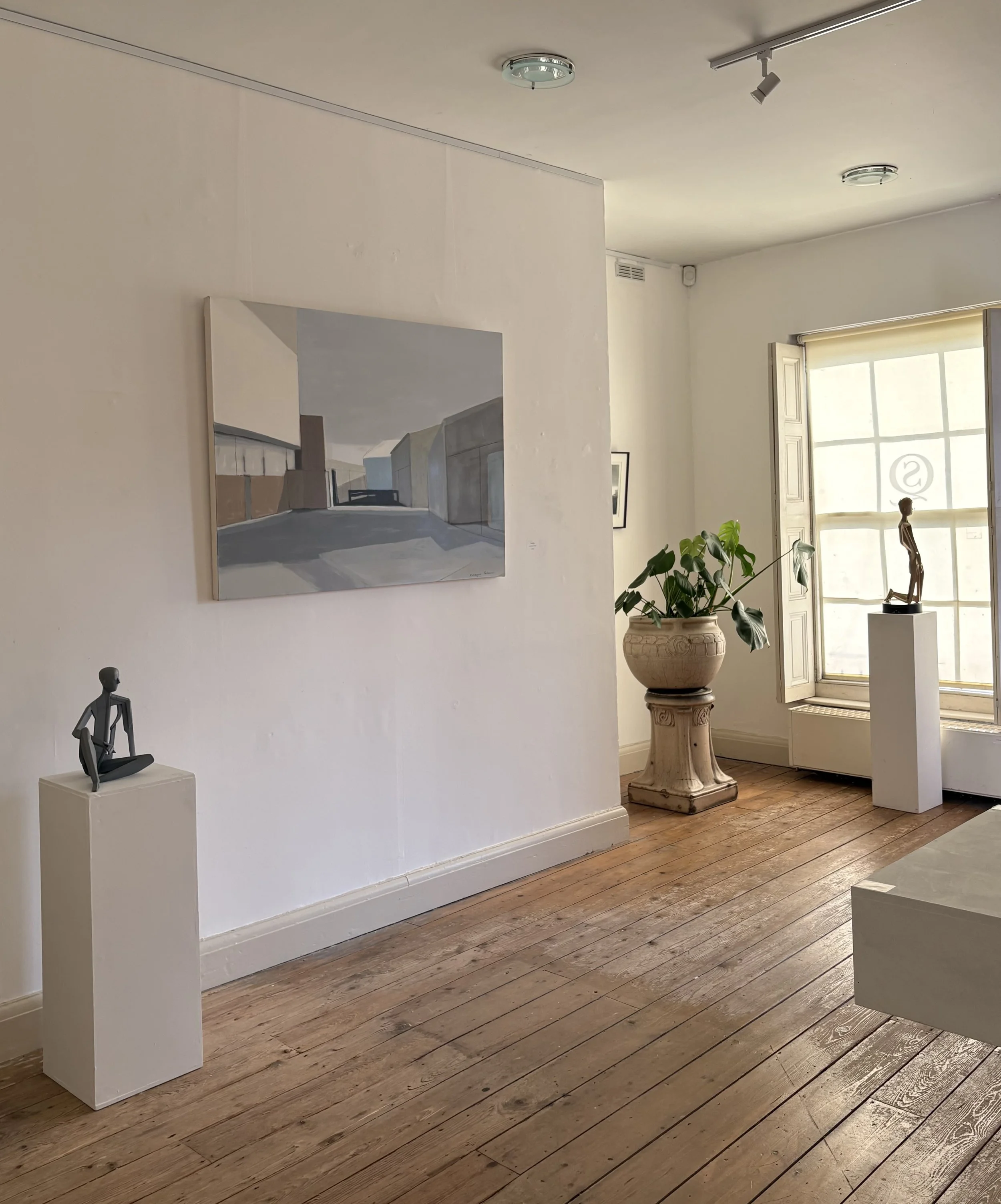
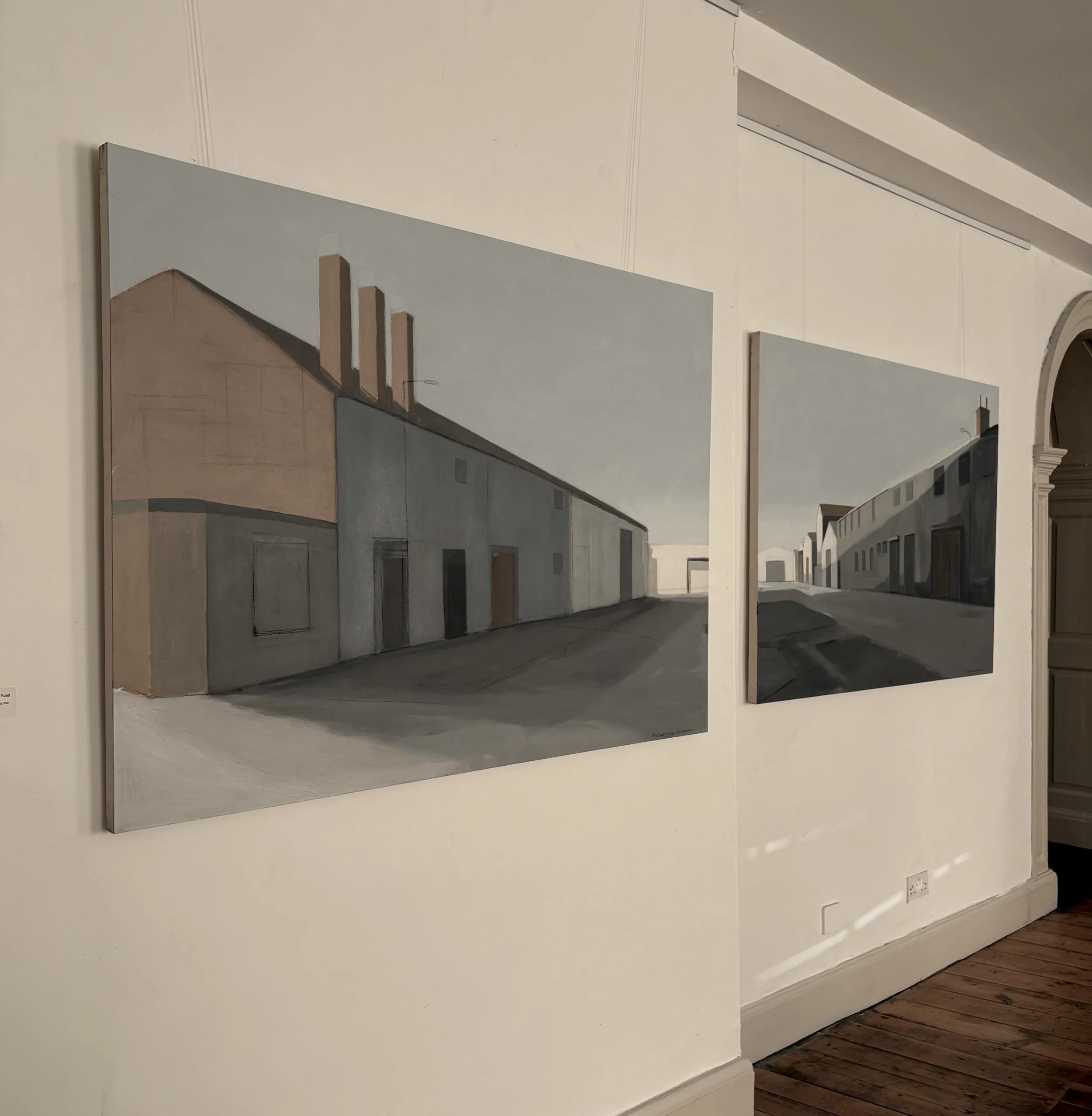
In each work, there is a tension between the blocking of form and the illusion of light and perspective. Facets of buildings are reduced to straight-edged masses, layered and abutted with a simple rigour that recalls geometric abstraction or constructivism. This flattening effect is foiled by hand-drawn gestures that create space within the composition and identify the surrounding forms as wall, road or roof. The fine lines of down pipes, electricity poles or streetlights are a final touch, completing the work with a perfect mark. The most recent paintings capture the view from the top floor of a repurposed office block just around the corner from Coleman’s studio. Focussing on the rooftops alone, they place us in a different terrain, far above the streets below.
Coleman works on a number of canvases at a time and for many years has made prints concurrently with the development of paintings. For Constructive, she has made a series of monoprints. Based on the same study of the South Denes area they are clearly related to the canvases, yet they have a distinct character which is perhaps closer to the fluidity and spontaneity of the initial observational drawings.
Bridget Heriz works from a studio not half a mile away from Coleman’s, across the Herring Bridge on the other side of the river. Heriz’s work is determinately figurative, yet it shares the same sense of the ‘beautiful, mysterious and deeply human’.
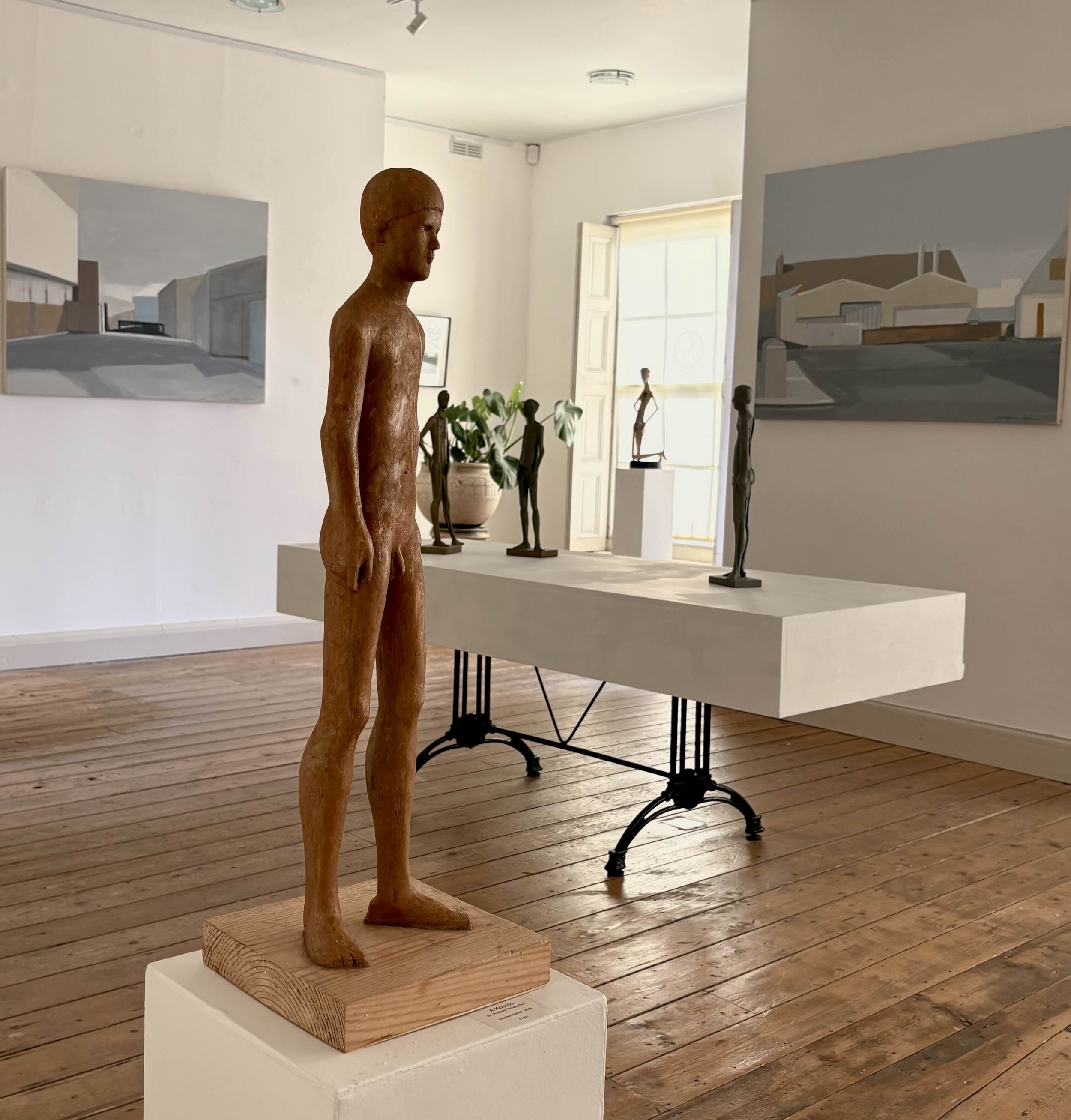
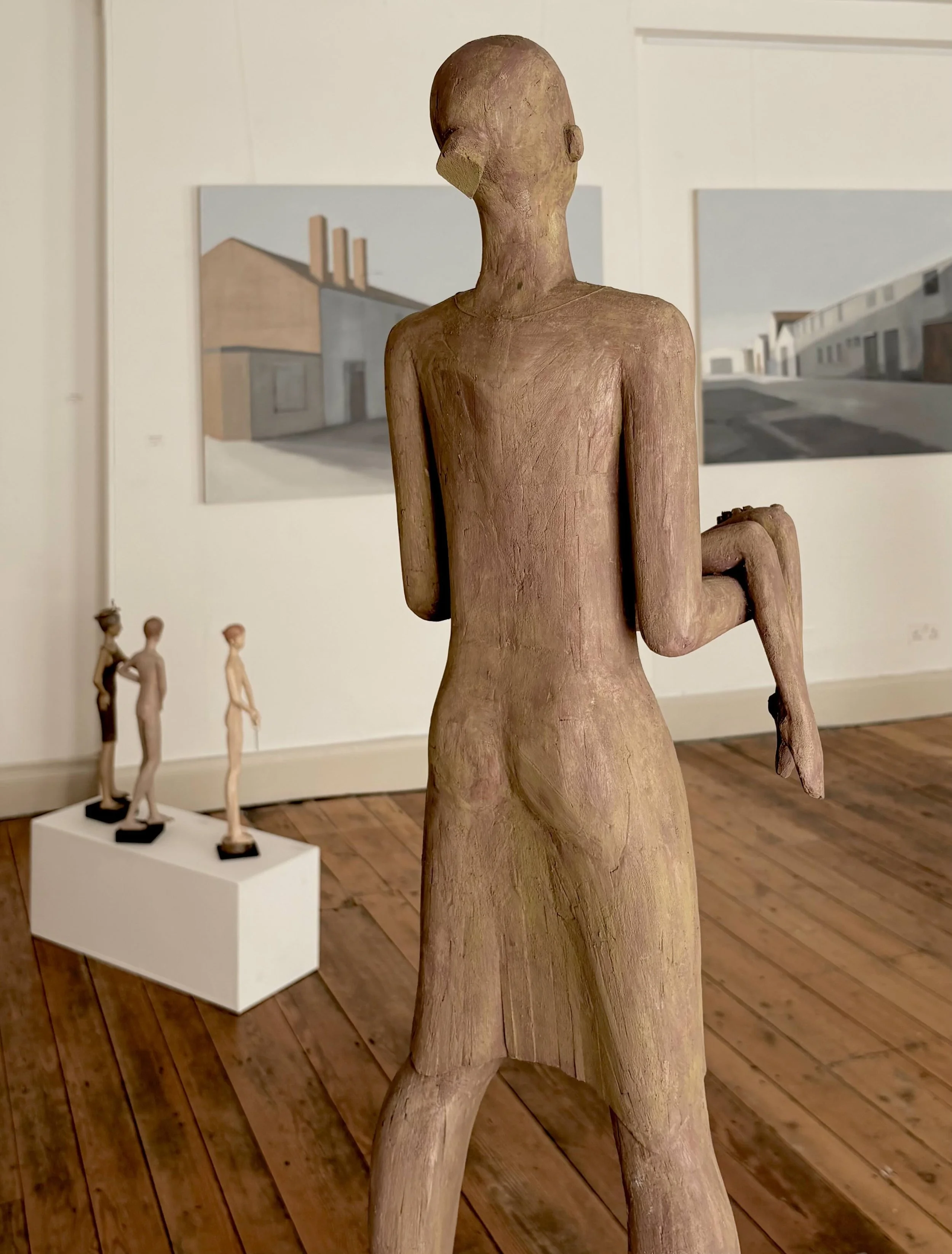
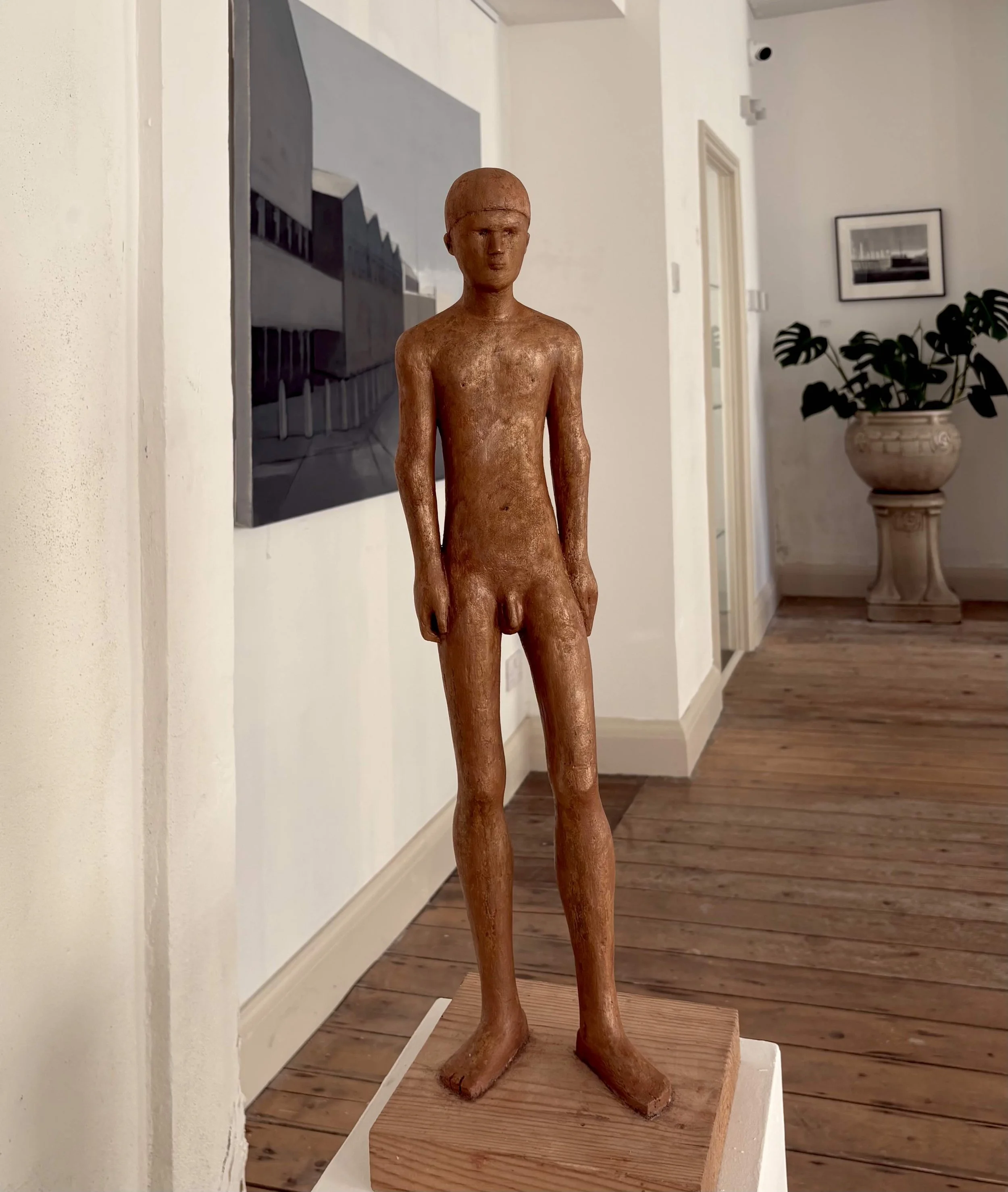
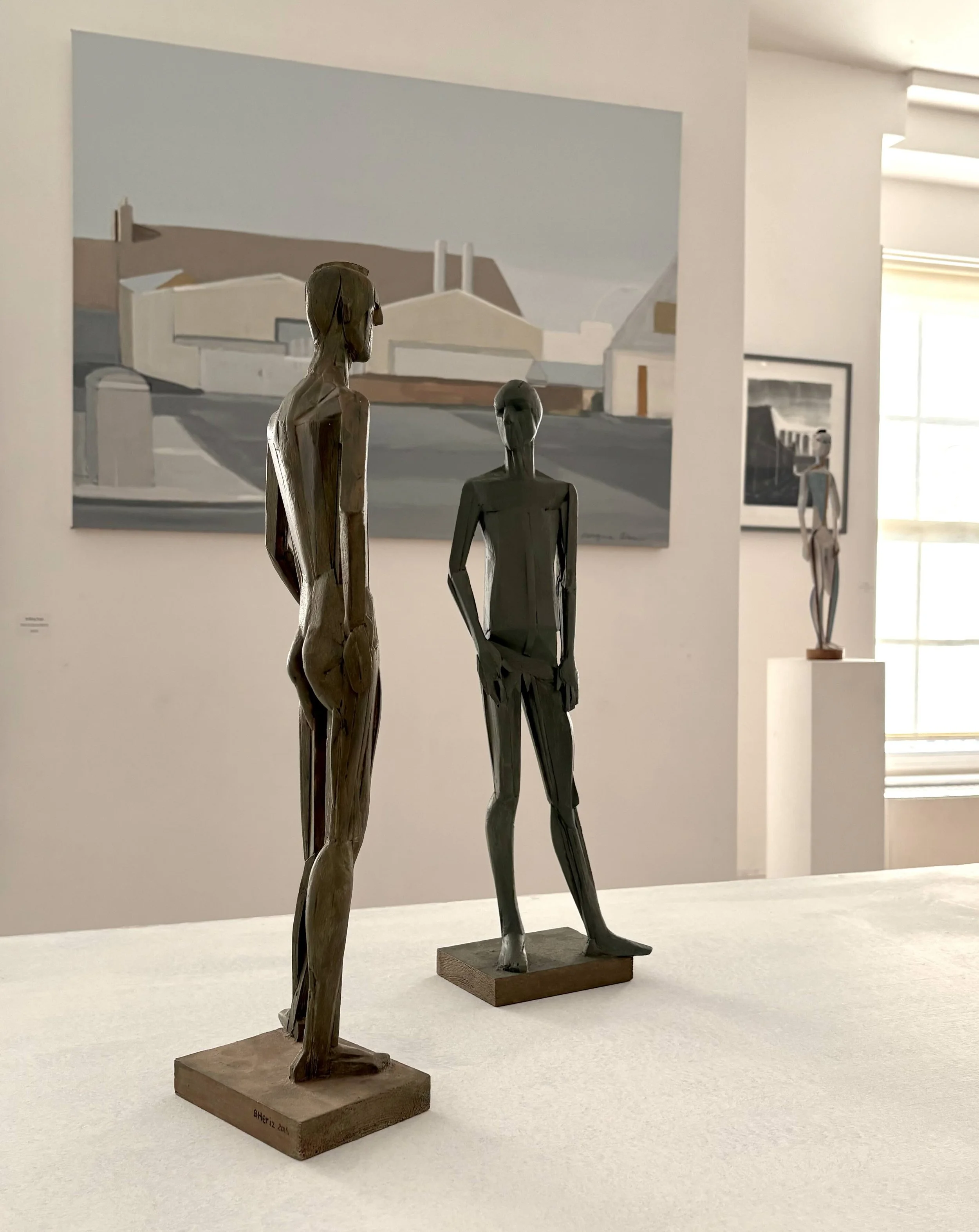
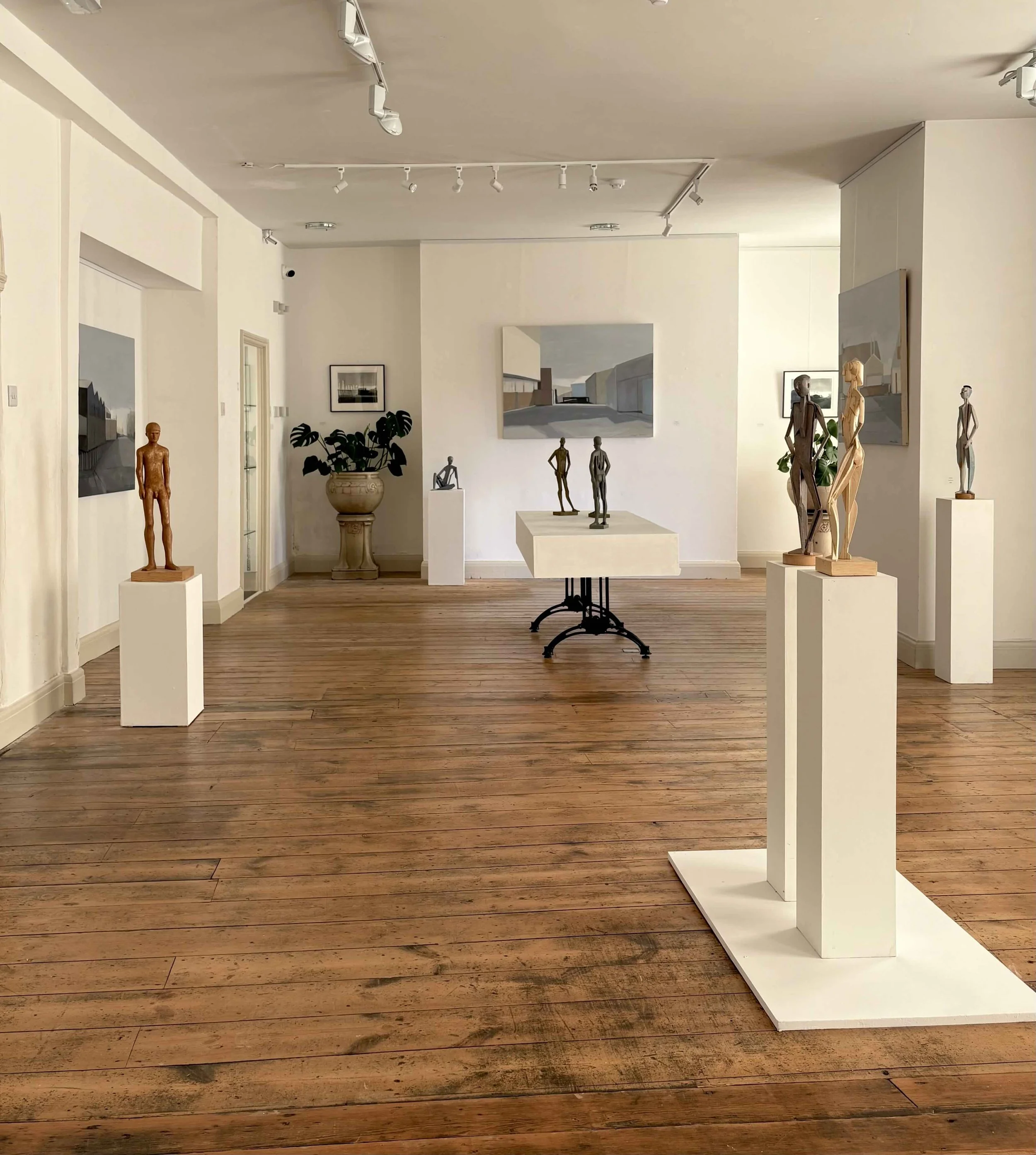
Heriz’s sculptures and drawings are distinguished by figures that appear simultaneously timeless and yet entirely present in the moment. They stand or recline in perfect balance, watching. The gravity of their gaze sometimes finds counterpoint in the levity of a pose or the humour of a creature perched on the head. The figures are all modest in size and with many the fine and precise construction from planes of balsa wood adhered around a wire frame remains perfectly explicit. Despite an animate quality, Heriz’s figures give an impression of quiet sentience, of absorption rather than response. Looking closely at their watching, we are met with the intensity of their returning gaze.
One day last year, Heriz entered her studio as usual and for the first time as an artist felt ‘hollowed out’. She describes suddenly having nothing to give - a bleak, empty feeling akin to a writer’s block. It is apposite that the escape from the hollow place and path back to making lay in writing. For the last months of 2025, Heriz wrote prodigiously, morning and evening, in a feverish working through of long-held concerns and preoccupations, explaining and exploring all the horrors of this new world in which we find ourselves. In the final essay, An Insistence on Control, Heriz describes how we are witness to military atrocities, subject to grossly unethical and incompetent leaders, ensnared in monetary systems that ensure the extreme wealth of some and the poverty of most and exploited by digital constructs that steal our identities. In a searing text that places current human behaviour in relationship to classical philosophy and ancient legends, Heriz implores us to notice what she understands and to imagine how we might together do better.
“Seeds can be shared and the ground prepared so that one day we might harvest a wiser ‘new’ world should that prove possible. ”
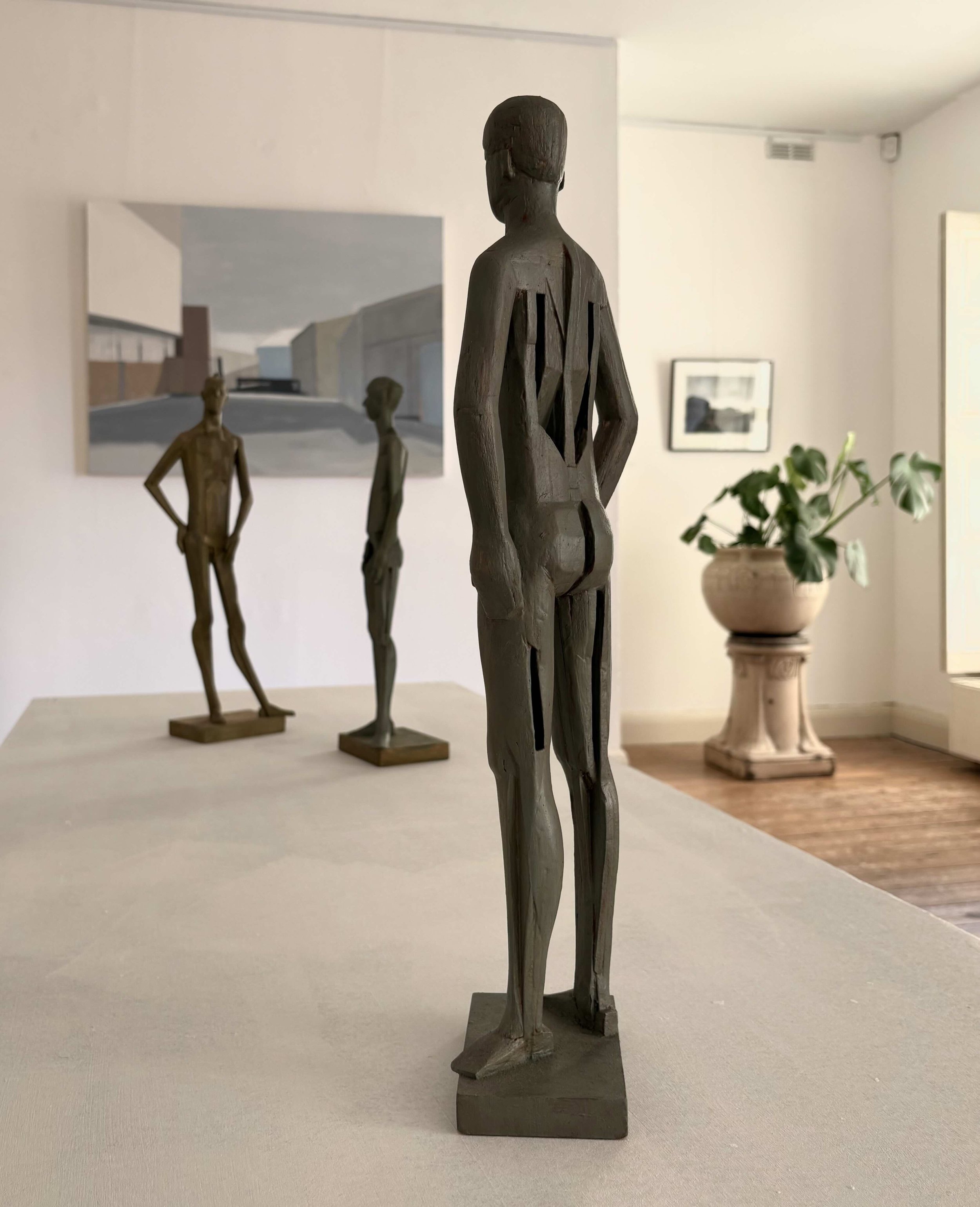
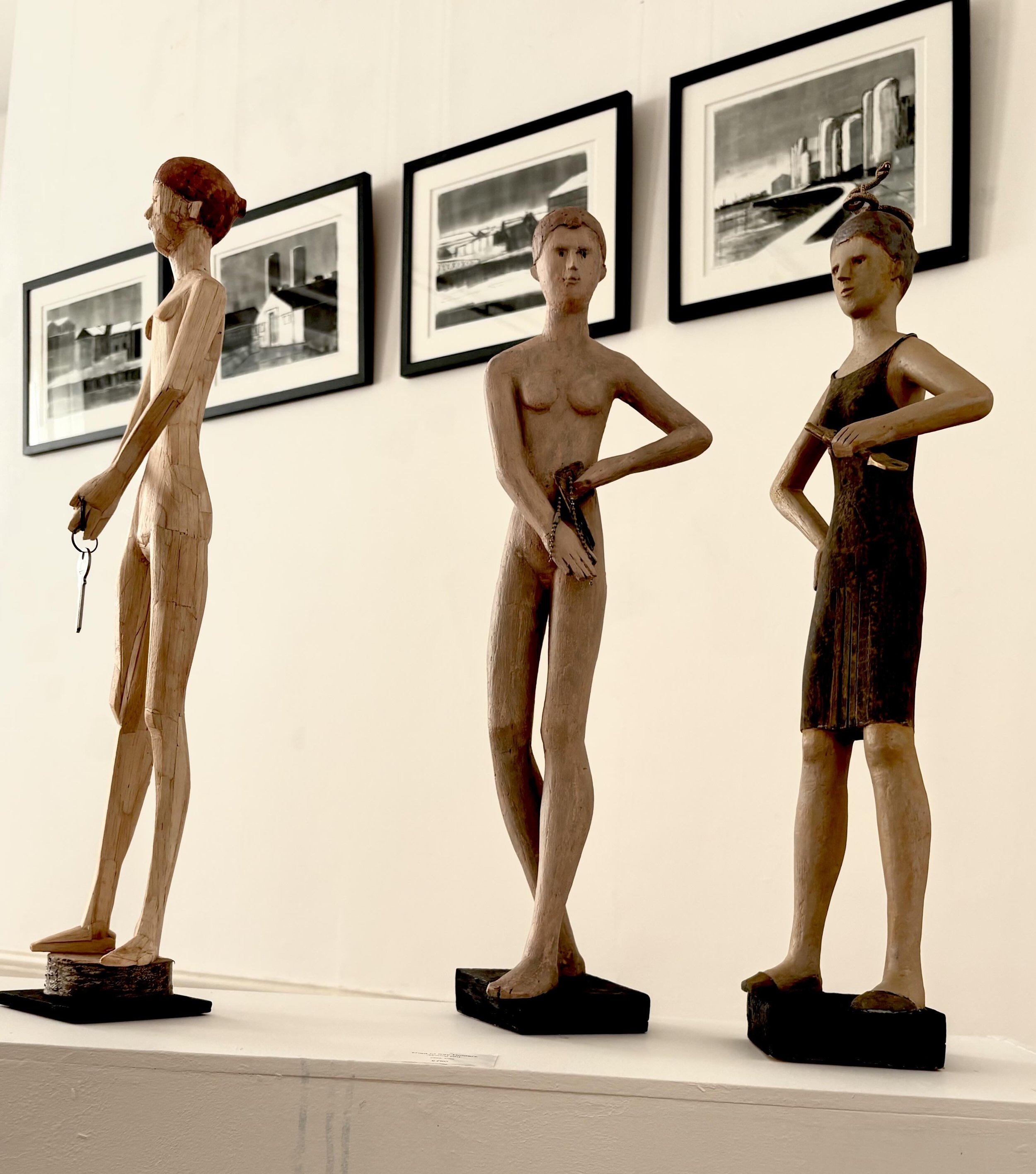
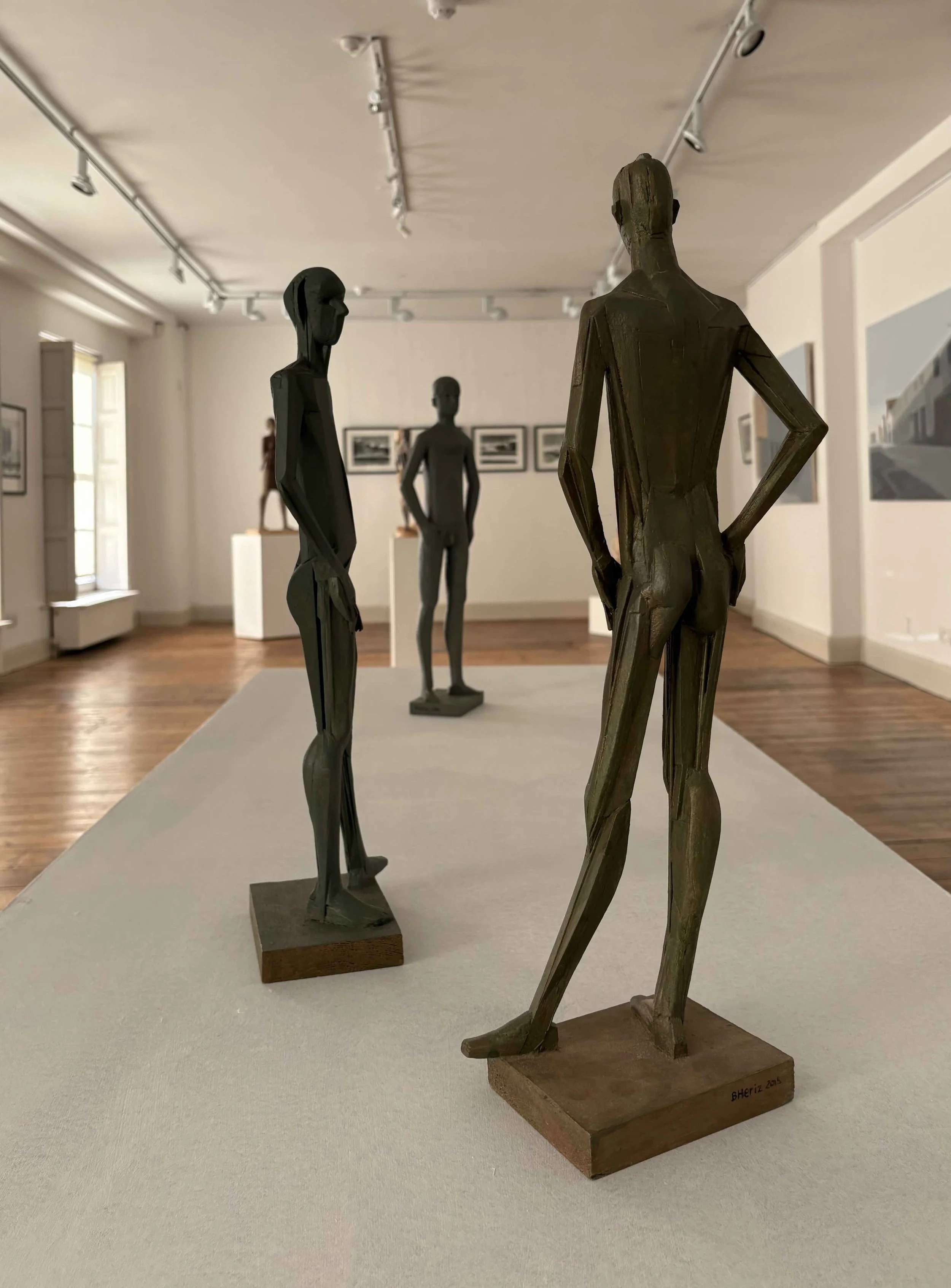
The works that Heriz made on return to the studio feature male figures, which she describes affectionately as ‘lads’. Some can be traced to recent life-drawing classes at South Quay Gallery. In these works, Heriz extends drawing as anatomical observation to three dimensions, with a compassionate curiosity about the inner lives and challenges facing the young men in her community. These figures have strength and dignity, but also a vulnerability gently conveyed in the attitude of the head or fall of an arm by the hip.
With Heriz’s remarkable text in hand, I arrived at Coleman’s studio last month. A phrase from our conversation there lingers in my mind: Coleman noted that her paintings may look ordered and calm but that’s not how she feels about them, she said that they are seething. In the work of both artists, clarity of line and composition is not an expression of tranquillity or contentment. Coleman’s images, in their muted colour and precise perspective, are brimming with intention, meaning and experience. Both artists make work that is absolutely of Great Yarmouth, keenly attuned to their immediate physical and social environment. In their distillation of this place, they make work with far reaching relevance that might speak equally of other times and places.
Coleman and Heriz could be described as purists; their careers are characterised by a fidelity to their subjects and an enduring fascination with the ‘inside-outness’ of structures. Each artist’s work is instantly recognisable and yet there is much in common, allowing these works to be comfortable in each other’s company. With a shared element of emotional restraint, their works have a quality of silence that evokes what remains unsaid.
Now for the first time and with this exhibition together, it is tempting to imagine that Heriz’s figures might briefly stand to populate Coleman’s landscapes. Their works invite us to spend time, look, and remain attentive to what might be understood from close observation.
Constructive continues at the South Quay Gallery, Great Yarmouth, NR30 2RG until 31 August.
The Gallery is open Wednesday to Sunday 1000 until 1800.